
The importance of bodies—and control thereover—has been recognized much longer and holds more sway than you would think. Habeus corpus (lit. “you shall have the body”) is a foundational concept of many legal systems, and is intended to guard against the physical detainment of a (living) body without just cause. But even dead bodies have power. In fact, there is even a term for battles fought over corpses—Leichenkämpfe. Homer’s description of the Leichenkampf over the corpse of Achilles’ companion Patroclus during the siege of Troy suggests that the impulse to control bodies predates even the arrival of the written word…and still makes headlines today. Would you do battle over a dead body?
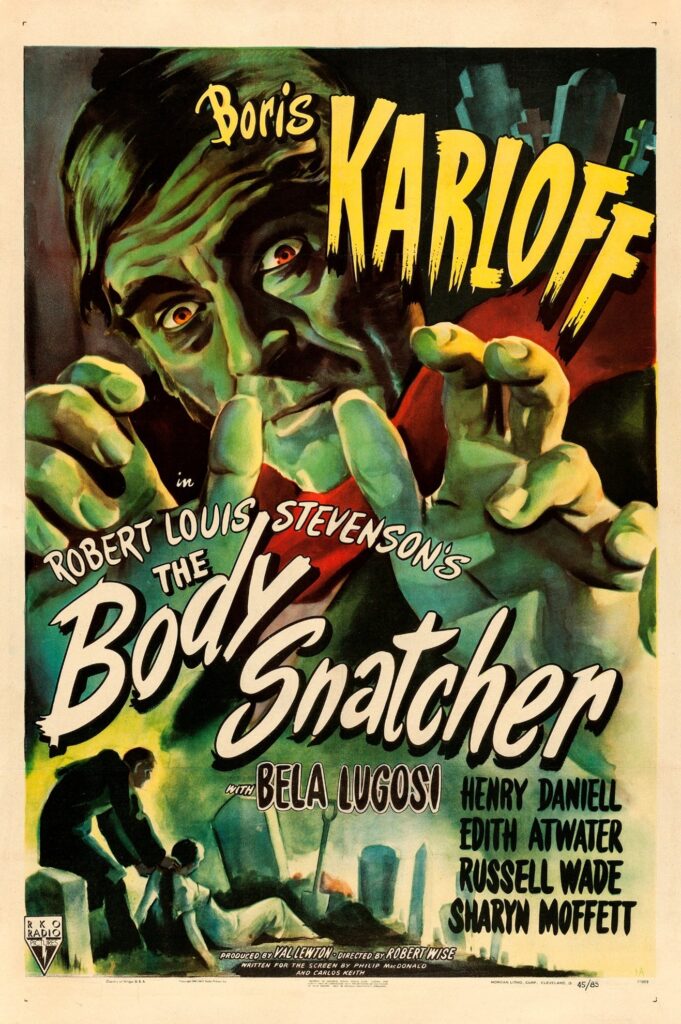
Today, many people dedicate their bodies to science after their demise or become organ doners by choice. However, in the 18th and 19th centuries, people thought a little differently about the physical form, especially those with a traditional Western background. At the time, Christian doctrine held to “universal resurrection”: the belief that the entirety of the physical body was necessary for obtaining a spiritual presence in the afterlife (e.g. 1 Corinthians 15: 35-54). For this reason, it was extremely difficult to obtain human bodies for academic study. In fact, medical students were so desperate for study material that they began to pay “resurrection men” to steal recent corpses from their graves and to deliver them to the dissection table. Although widespread belief in universal resurrection eventually subsided, corpse theft was so reviled that it was vilified in literature. Mary Shelley made use of body snatching as a shadowy extended metaphor in Frankenstein and Robert Louis Stevenson wrote a short story in 1884 on corpse theft. See Figure 1. It was—quite literally—the invasion of the body snatchers!
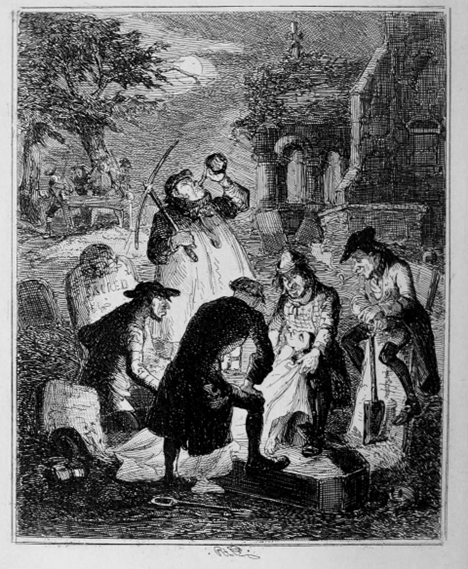
An excellent illustration of the degree to which body snatching was hated and feared by contemporary Europeans comes from the case of two “resurrection men” who were caught red handed in 1777. After the trial, perpetrators John Holmes and Peter Williams were sentenced to be publicly whipped as they ran from Holborn to St. Giles (a distance of about a kilometer) in London, England. See Figure 2. The irony is that the living bodies of Holmes and Williams paid a steep physical toll for having made off with the remains of those who were themselves beyond pain. Was it worth the price?
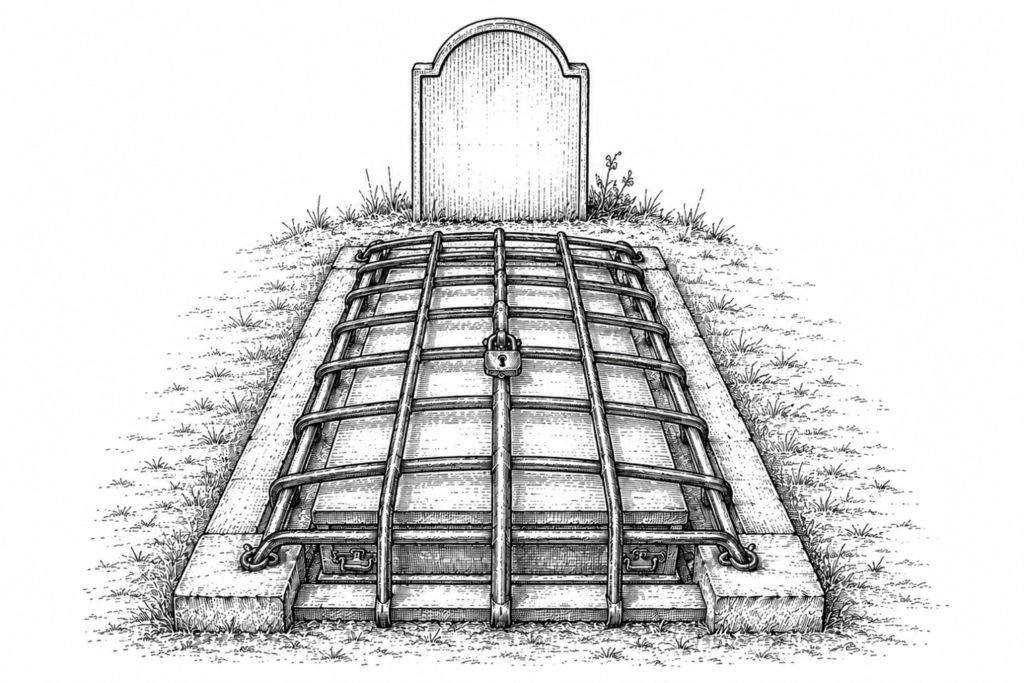
Still today, most surgeons and anatomists will tell you that there is no substitute for studying real human bodies, though they often make use of plaster casts for demonstrations and teaching. Unfortunately, high-quality casts are a very recent invention. Back in the day, medical professionals had no other recourse for creating the knowledge that would help save lives. Therefore, they considered body snatching a necessary evil. The populace responded in kind. Those who could afford it buried their loved ones under what was known as “mortsafes”: iron cages or brick walls intended to prevent any later re-opening of a coffin. See Figure 3. Mortsafe literally means “death safe”…a sure way to make sure that the deceased would stay where you put them!
In 1751, a compromise (of sorts) was reached. The British government passed the Murder Act. This gave medical schools the right to dissect the bodies of murderers and was intended both as a crime deterrent as well as assist for medical research. But even this could not stem the demand for fresh corpses. In 1828, a terrible story came to light. Two men living in Edinburg—William Burke and William Hare—had deliberately murdered 16 people for the express purpose of selling their bodies to an anatomy school. In exchange for clemency from the King’s justice, Hare testified against his erstwhile partner. Burke was tried, executed and his body underwent public dissection before being put on display at Edinburgh Medical School’s Anatomical Museum. Some might call that poetic justice…but that might just be my gallows humour talking.
The case of the Edinburgh body snatchers was followed in 1831 by the “London Burkers”…two other men, who ran a similar scheme: killing and selling the bodies of their victims to anatomists. Such atrocities eventually led to Britain’s Anatomy Act of 1832, which legalized the body trade. However, the body trade was still far from fair. Although it did allow for bodies (and not just those of murderers) to be legitimately claimed for medical study, the bodies themselves came from marginalized groups who could/would not pay a burial fee. In turn, this meant that those bodies were largely sourced from poorer homes, asylums, hospitals and workhouses. The poor and downtrodden paid with their bodies what others paid in coin.
And bodies are worth coin. The trade in human bodies and -parts is collectively known today as the “red market”. India in particular was a hotspot for the preparation for human remains for anatomical schools. Before they placed a ban on the export of human bones from India in 1985, it is estimated that 60,000 skeletons were exported yearly. That is enough for every medical student the world over to have bought a body alongside his or her textbooks!
Having bodies—or even parts of bodies—makes a statement, confers power, confers knowledge and is a source for no little financial advantage. Today, the Council of Europe reports that up to one in three Europeans dies while waiting for an organ transplant, and that this frightening figure has brought about even more horrifying abuse: the rise of “transplant tourism”, in which wealthy persons travel to poorer regions for organ transplants from less well-off doners. Though we often say that there can be no price put on human life, history is very clear that bodies have a hefty price tag attached. So…how much are you worth? In the black market “red trade”, your skull alone might fetch between €1-3000. Think of that the next time you look in the mirror and feel down on yourself.