
Before death certificates were a thing, people tried to preserve bodies as proof of death. Evidence suggests that this was practiced in Europe at least from the 6th century AD to help with questions of royal succession. Interestingly, the first step in preserving a body is to remove its organs (particularly the entrails, as these are the first to putrefy). If the body had been divided into parts (for preservation and to prevent immediate decomposition), then it stands to reason that the different parts could be put to different uses…but what would go where?
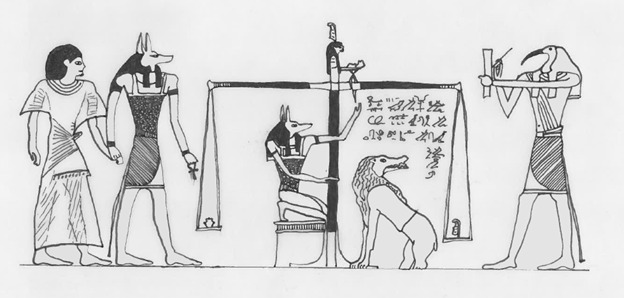
Figure 1. Line drawing of excerpt from the Book of the Dead of Hunefer, circa 1285 BC. In this image, the deceased (being led by the hand at left) is having his heart (in the jar on left side of scale) weighed against the feather of truth for judgement (right side of scale). The ancient Egyptians believed that the heart recorded each person’s actions throughout life, thus becoming ‘heavier’ should its owner complete bad or otherwise sinful actions. The original is held at the British Museum; here re-drawn by S. Reiter.
The heart has particular significance in the West as a symbolic midway point between spirit and mind. It is thought to represent the essence of self when all other parts are stripped away. In the Middle Ages, Europeans began a curious funerary practice in which they divided the corpse into separate pieces (often of body, entrails and heart, or even just body and heart). Because of its symbolism, particular importance was placed upon the placement of the heart, and the practice of heart burial was born. The persons and places to which people have historically sent their hearts have expressed piety, loyalty, love and devotion. Here we seek out historical examples of places and peoples with whom hearts rested in peace.
The origins of the thinking behind “heart burial” likely stretch back into antiquity. Ancient Egyptians viewed the heart as the center of emotion, memory and personality; see Figure 1. Many ancient writers–including Aristotle–held this belief, also. So important was the heart that it was examined for signs of sanctity upon the death of someone who might become a saint. This was the case for Clare de Montefalco, a nun who died in 1308 and whose heart was purportedly found to contain small religious symbols, including a crucifix.
Sometimes, the heart itself and its placement after death were the greater symbol. Richard I of England, also known as Richard “the Lionheart” died in 1199 in Châlus, near Limoges, France. His body was divided for separate burial: his entrails remained in Châlus, his body was sent to Fontevraud Abbey and his mummified heart was sent to the cathedral of Nôtre Dame in Rouen, Normandy. In the Middle Ages, the location of the heart burials may have been a traditional symbol of loyalty; in the Lionheart’s day, Normandy was the seat of the English occupation. Richard I used the placement of his heart to symbolize his piety and his loyalty to his men and his home in one fell swoop.
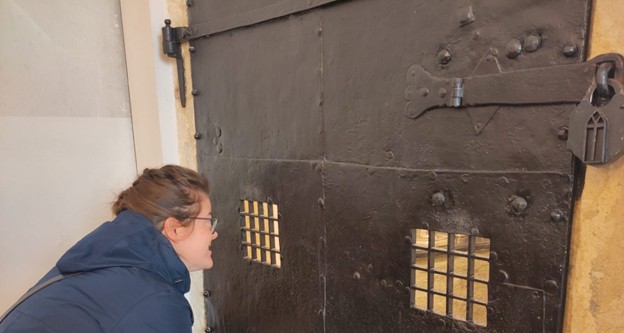
Figure 2. Reiter peers into the Hapsburg Herzgruft. Photo by J. Shoemark.
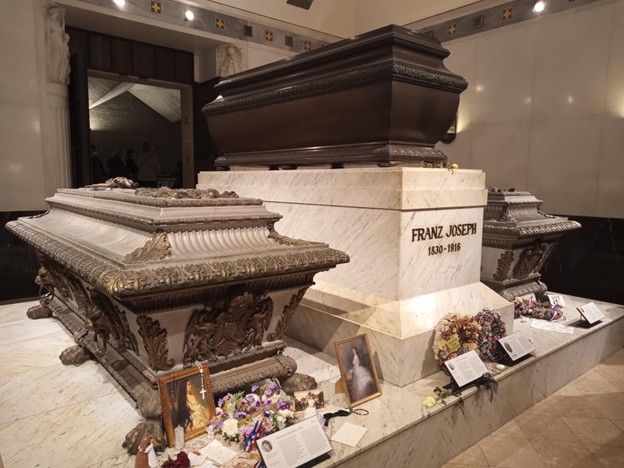
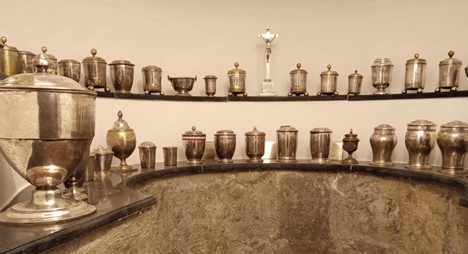
Figure 3. The interior of the Herzgruft as seen through the grille. Photo by S. Reiter.
Figure 4. The imperial sarcophagi of Empress Sisi (L) and Emperor Franz Joseph (R) in the Kapuzinergruft. Photo by S. Reiter in November, 2025.
The longest-standing heart burial tradition in Europe began in 1654 and was recently overturned in a tellingly poignant manner. Today, fifty-four hearts from the Hapsburg family are interred in the Herzgruft (Lit “heat crypt”) in a chapel of the Augustinian Church at Hofburg palace, while their other earthly remains were buried nearby in the Kapuzinerguft (“crypt of the Capucin [friars]”), both in Vienna, Austria. See Figures 2-4.
However, when Otto von Hapsburg, last heir of the Hapsburg empire died in 2011, his burial made an important symbolic break with tradition. While his body was placed in the Kapuzinergruft, his heart was sent not to Vienna, ancient capital of the Hapsburg empire, but to the Benedictine Abbey in Pannonhalma, Hungary. Why? To show his love and affection for Hungary and its people. By dividing body and heart, the last Hapsburg heir honoured both his forebears and their traditions as well as the people and culture which had—quite literally—taken his heart.
Other examples of heart burial are just as emotional and equally demonstrative of love and devotion, but in a more personal sense. Recent excavations at the Jacobin Convent near Rennes, Brittany (France) tell a heartbreakingly romantic tale. The hearts of 17th century Jacobin husband and wife duo Toussaint de Perrient and Louise de Quengo were removed and placed on each other’s coffins. This is proof positive that “until death do us part” need not always be the case.
Perhaps it may seem macabre to some, but the tradition of the heart finding its way to a place—or person—which was held dear has even been practiced within modern times. Percy Bysshe Shelley, considered one of the great English Romantic poets drowned off of the coast of Italy after a boating accident in 1822. In accordance to Italian law, his body was immediately cremated on a beach near Viareggio. Those in attendance reported that Shelley’s heart had been “calcified” (supposedly from a previous illness) and would not burn. Friend and fellow author Edward Trelawny was present at Shelley’s cremation and plucked the poet’s heart from the coals and had it pickled in spirits. Shelley’s heart eventually made its way to his widow Mary Shelley (author of Frankenstein). Mary kept her husband’s heart wrapped in silk and examples of the poet’s own work in her desk drawer until her own death, when she was buried together with it in the family crypt in Bournemouth, UK. See Figure 5-6.
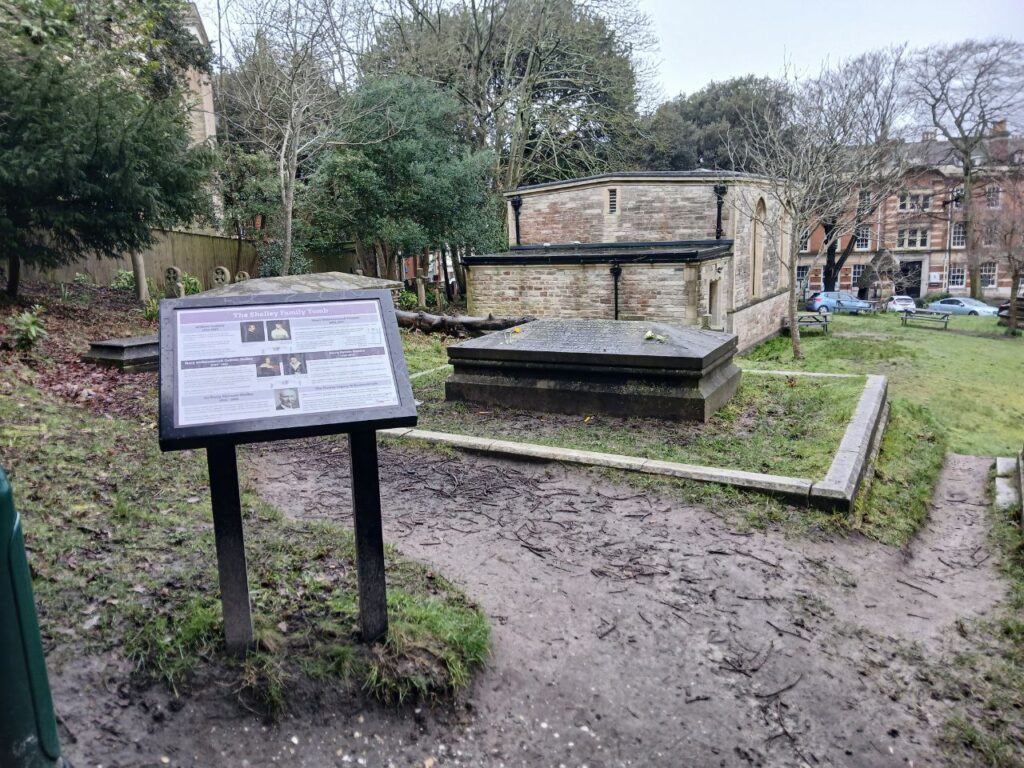
Figure 5. Location of the Shelley family crypt in St. Peters Churchyard, Bournemouth, UK. Photo by R. Lee, with permission.
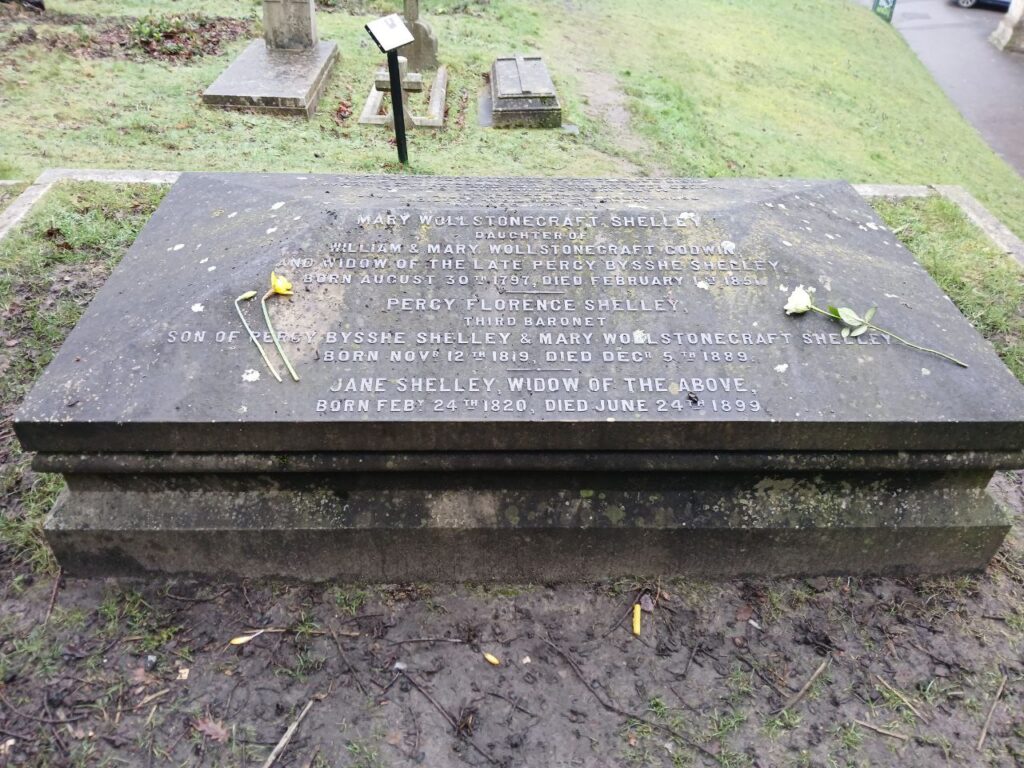
Figure 6. Overview of Shelley family crypt. Photo by R. Lee, with permission.
The song made famous by Tony Bennet intones “I left my heart in San Francisco”. By that he referred not to heart burial, but rather expressed the dichotomy of being away from a place that he loved. Nevertheless, it embodies a very important question. When all that remains of us are remains themselves, where would you want your heart to dwell? Perhaps the curious practice of heart burial still has meaning once body and spirit are sundered. In resting in pieces, perhaps we can better find the place where we can rest in peace.
Interesting and well-written!
Love the idea of the heart is the essence of the person🙏