
When was the last time you took a photo of a loved one or a selfie of yourself? It is probably not too long ago! But did it cross your mind that this image could still be around in a few hundred years, telling a story about you and your life? If yes, you have as much trust in the power of portraits as the people of Palmyra had. Palmyra, a city in the Syrian desert, is home to around 4000 portraits, carved in stone. The elite of the city used grave markers with their portrait busts to be remembered for eternity. This allow us to look at their lifes, 2000 year later, through their very own eyes. But what is about the stone carvers that actually made these portraits? What can we learn about them by looking at these very same portraits that show the upper class of a city? The answer is: a lot! The carvers left their traces over the portraits and that opens an entirely new window into the past and the organization of the craft of stonecarving.
Looking at portraits through the lense of their making is giving us a glimps into the organization and skillsets of stone carvers in Roman Palmyra. It shows that needs and wants of the elite was linked to more than just the choice whether they wanted to be shown with a beard or not. It also shows that carvers and customers, equally, had an influence on the portraits.
By combining the studies of the iconography (what is shown; why it is shown) and the production (how it was made), sheds light on the understudied group of craftspeople and allows us to see the portraits in a new light. This is why we need to start looking at the portraits as more than just a product that people looked at once it was finished but look at them as craft products in themselves.
The Study of Ancient Portraits
Remains from places such as Roman Palmyra are constant reminders of the human need to leave a trace in this world. In the case of portraiture, this trace is quite individual, leaving archaeologists with much to think about. One question constantly raised is the identity of the person depicted. The people able to afford a portrait are, however, often members of the past’s elites. A question that has not really been tackled is concerning the people who had the necessary skills to create the portraits – the stone carvers. Few carving workshops are known, and these workspaces barely are part of other visual art either. This results in a gap in our understanding of portraiture, as well as an important part of the society: the craftspeople. This gap also leaves us blind to individual choices the carvers and customers made and obstructs the story of the past that we tell. This picture can only be changed if we raise different questions and if we look at the portraits in an new light.
Palmyrene portraits will be our point of departure to do so. They are an excelent group to study when trying to find out more about portrait production. Palmyra is home to a large number of funerary portraits that decorated the walls of the tombs in the first three centuries AD. People either are shown as individual busts on a stone slab, or in their family constellations on sarcophagi lids and boxes. More than 4000 portraits are known today. This large group – the largest group of funerary portraiture from outside of Rome – can anwer many questions about the inhabitants of the city, their identity, and their habits. The large number also allows to ask exactly those new questions we need to understand the complexity of ancient societies and all of their members.
Producing Palmyrene Portraits
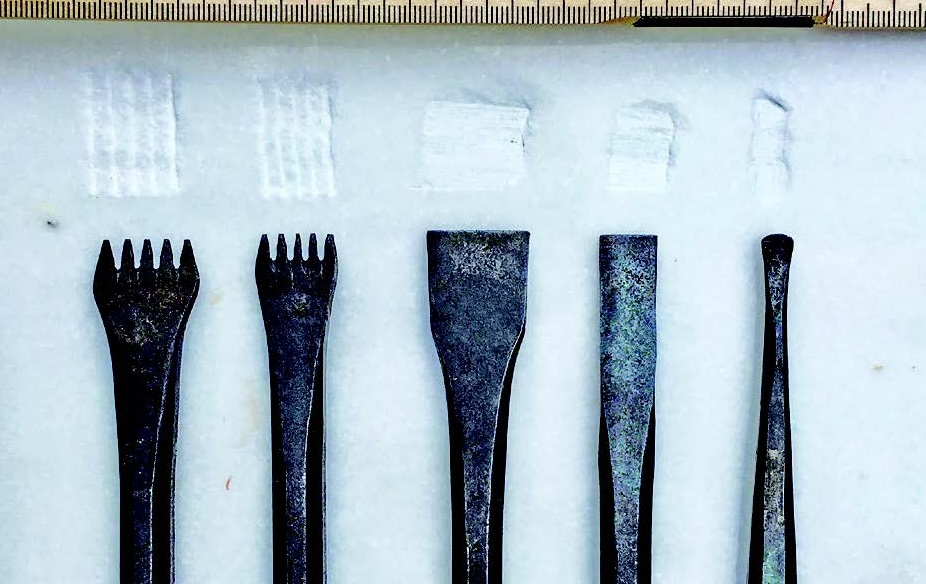
Commonly used stone carving tools made from metal, modern. From the collection of the Antikmuseet, Aarhus University (photo by the author).
Looking at stone-carved portraits, you will always be able to find tool traces, no matter how much work a craftsperson spend on polishing the surface. Next time you visit a museum, make sure to have a close look at the surface and you will be surprised (especially when you take a look at their backside)! The Palmyrene portraits are all made from local limestone that was quarried not too far from the city. Because limestone cannot be polished, the tool traces are still easy to detect. By documenting all these traces it was possible to reconstruct the sequence of steps the portraits were carved in, showing that Palmyrene carvers slightly changed their techniques over the years. An example is the use of the drill. Drill traces have barely been found on the earlier portraits but at some point the carvers picked this tool up and added it to their tool kit. Changes like these can be related to a changing economy, a change in style, and maybe even to a changing skill set of the carvers with each generation.
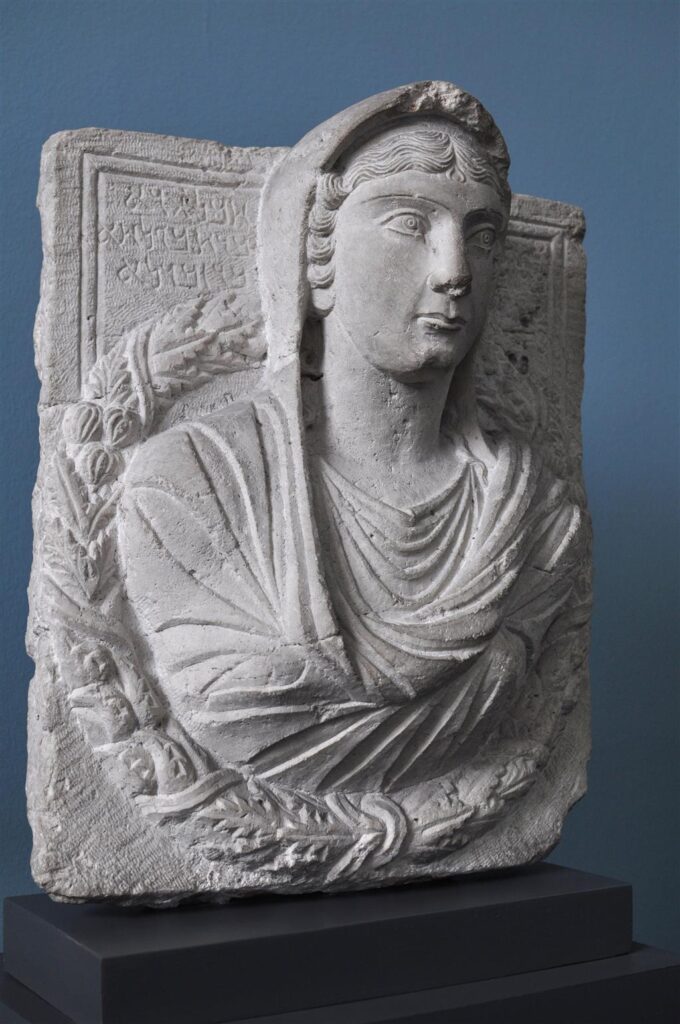
Marks of a tooth chisel in the background of a loculus relief (Ny Carlsberg Glyptotek, Copenhagen, IN 1155. Photo courtesy of the museum).
The conducted studies have also proven that the portraits were made on individualized orders. The conformability of the portraits as a group has often been seen as a sign of a mass-production where customers would only be able to choose an individualized inscription with the name of the deceased. However, the detailed study of the portraits and their making has shown that there is more variety than thought and that, actually, no two portraits look alike. It thus seems that there was a certain repertoire of elements to choose from, such as jewelry, brooches, or headband patterns. These are then, in endless variety, combined in the funerary portraits. The families were thus able to mix-and-match the funerary portrait of their choice. This reflects on a dynamic workshop situation and carvers that were skilled enough to meet the wishes of the customers.
It stays in the family
Despite this re-evaluation of the portraits as individualized products, the conformability cannot be denied. This lead us to think that families went back to the same workshop. Palmyrenes loved to mention the names of their (male) family members on their grave markers next to the portrait and reserachers have been able to reconstruct quite a few family trees. Through comparison of the portraits’ apperance and their carving, it was possible to say, with some certainty, that some families purchased portraits from the same workshop or carvers. One example is the family of Aḥîtôr. Sadly we do not have his portrait, we only know his name from a mention in his grandchildrens funerary inscriptions. We do know that he had (at least) three sons and these sons had children of their own – it is that generation that five funerary portraits survived from. Four men and one woman had their portrait carved – and they look astoundingly similar. Malkû and his two cousins, Bôrrofâ and ‘Atenatan, are shown with very similar facial features. The same features can be found in Malkû’s nephew, also called ‘Atenatan. Yet another great-grandchild of Aḥîtôr, Bôlḥâ (cousin of the younger ‘Atenatan), displays similar features as well. This shows that families seemingly went back to the same workshop over multiple generations; either because the chosen workshop was in their budget, or they wanted to achieve family similarities through chosing acertain workshop with a certain carving style.
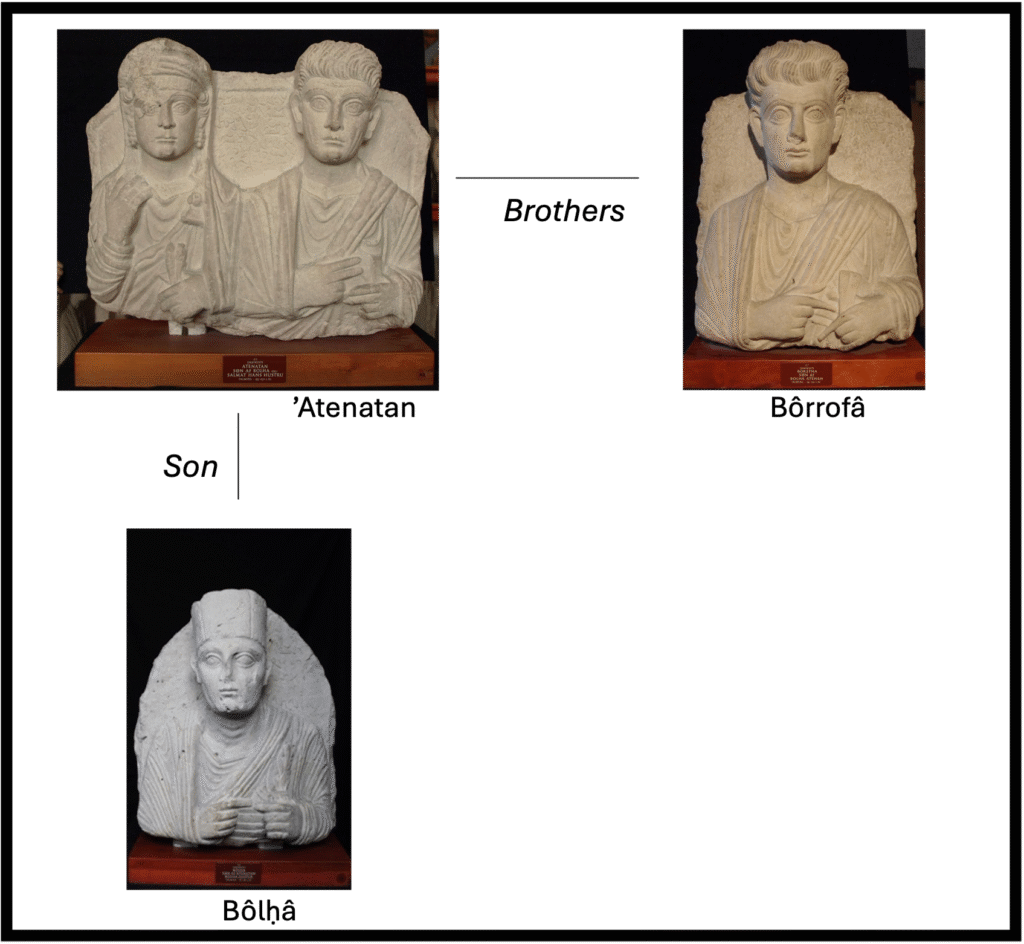
Two generations of Palmyrenes used the same workshop for their grave markers. Parallels can be seen in the facial features (for example the large, wide-open eyes) as well as the way the portraits are carved (Ny Carlsberg Glyptotek, Copenhagen,
IN 1028/ IN 1037/ IN 1032. Photo courtesy of the museum).
Changing the narrative
Instead of assuming that the Palmyrenes walked into a workshop and had to take a pre-produced portrait off the shelf, it is more likely that they commissioned a portrait to their liking, choosing the different elements to be shown and returning to the same workshop over time. On the one hand, the customers thus had a larger influence on the final product than previously assumed. On the other hand, the carvers and their skills also had a major influence on the portraits that have gone unseen in the past. Only by combining all the information we can gain from the portraiture, the what, the how, and the why, we can get a step closer in understanding more about past societies, such as their structure, coexistense, values, and sometimes even the choices that some individuals took.
The story of course does not end here. On top of studying the carvers techniques, skills, and the organization of the production, factors such as ressource management, cross-craft collaboration and material choice need to be taken into consideration. An example is the import of more valuable stones. If a marble statue is found in the Syrian desert, a region without natural marble, it means that the stone traveled a long distance, which was a costly practice. In Palmyra marble was only used for a small number of sculptures from the public sphere; all funerary portraits were made from the local (and thus cheaper) limestone.
The 4000 portraits from Palmyra tell many stories – about Palmyra’s craftspeople and Palmyra’s elite likewise. Comparing them to our need of capturing moment and people in photos does not do them justice because each portrait was hand-made in weeks of work, by skilled carvers that started each portrait from scratch and honoured the wishes of the families. Each portrait tells its own story and yet contributes to the larger picture of a past society and its organization. However, they also tell a story that is as old as humanity – the power of creation.