
This snack was first posted on the Scisnack website on 21 April 2024.
(Re)moving the dead
Death is very quickly followed by movement (or re-movement) of the remains. Swedish author Knausgaard poetically describes this urge: “the way we remove bodies has never been a subject of debate; it has always been just something we have done, out of a necessity for which no one can state a reason, but which everyone feels.” Today, the removal and storage of human remains is regulated by law (e.g. Britain’s Human Tissue Act of 2004). In the past, the preparation and removal of human bodies was mandated through cultural tradition. Deuteronomy 21:23 instructs us that burial should take place “on the same day.” Removal of a dead body from the living environment—both today and in the past—is a question of protecting the living. A body begins to decay immediately after death; those changes become visible within 18-24 hours and can pose a health risk if the body is not handled properly (i.e. refrigeration or embalming). Removal of human remains from the realm of the living can literally be the difference between life and death.
But when were people first aware of the need or impetus to move/re-move the dead? Recent work at near to Johannesburg, South Africa suggests that the first potential removal of the dead for deliberate burial may date from as early as 335,000 years ago. Two burials at Rising Star Cave have been accredited to Homo naledi, an early human ancestor who walked upright, but may have also spent a great deal of time in the trees. Nevertheless, it seems that hominids—early or not—are not the only living creatures that bury their dead. Although elephants graveyards as such do not exist (recent research shows them to be the result of natural phenomena), both elephants and chimpanzees have been observed to cover the dead with grass and small stones. Fascinatingly, thanatological studies on the science of death among social insects also indicate that certain chemical cues will trigger corpse management behavior.
Managing the dead
Management of the dead has recently been gaining increasing traction as an important issue in the West. While insects may outnumber us, put together, the sheer biological mass of humanity is a force to be reckoned with. How can we manage the dead in a way that is respectful, sanitary and also sustainable? In the past, the world was a larger place (in the sense that humanity’s presence upon it was far less dense). Bodies could be embalmed and wrapped in linen bandages then entombed in elaborate sarcophagi as we know from ancient Egypt. Alternatively, they could be left out to the elements in the so-called ‘sky burials’ of central Asia or the bodies could be cremated and placed in a river like the Ganges or other special place, as is still practiced in modern day India.
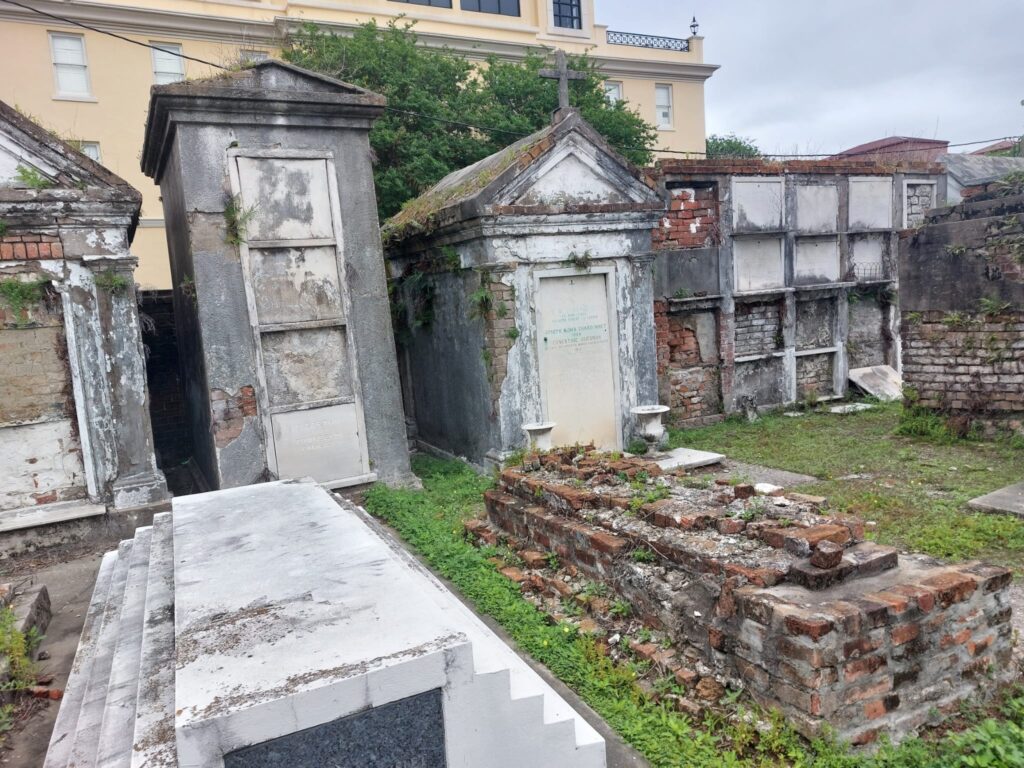
But what about in places where—even in the past—the world was smaller, or otherwise hemmed in? Cemetery No. 1 in New Orleans, Louisiana is the oldest cemetery remaining in the city, dating from 1789, the year of the French Revolution. Because of its high water table, it was incredibly difficult to ‘bury’ the dead in New Orleans (as they kept coming back up out of the ground every time the ground got a little too wet…which was often in the Crescent City, and likely also contributed to the city’s legendary association with voodoo and the occult). As a result, the early residents had to come up with another solution: family mausoleums. Due to the heat which pervades the American South, these domed white vaults function as crematoria do. A body is placed in the top portion of a two-layer vault for a year and a day which, due to the omnipresent heat will reduce the remains to ash and dust. At the end of the allotted time, the remains are pulled out, any large parts are crushed and pushed to the opening at the back of the top portion of the mausoleum, where they fall in to the vault below to mingle with those who have gone before. Interestingly, the importance that is placed upon the ability to be buried in these family vaults is so great that location of eventual burial is often already negotiated within pre-nuptial agreements.
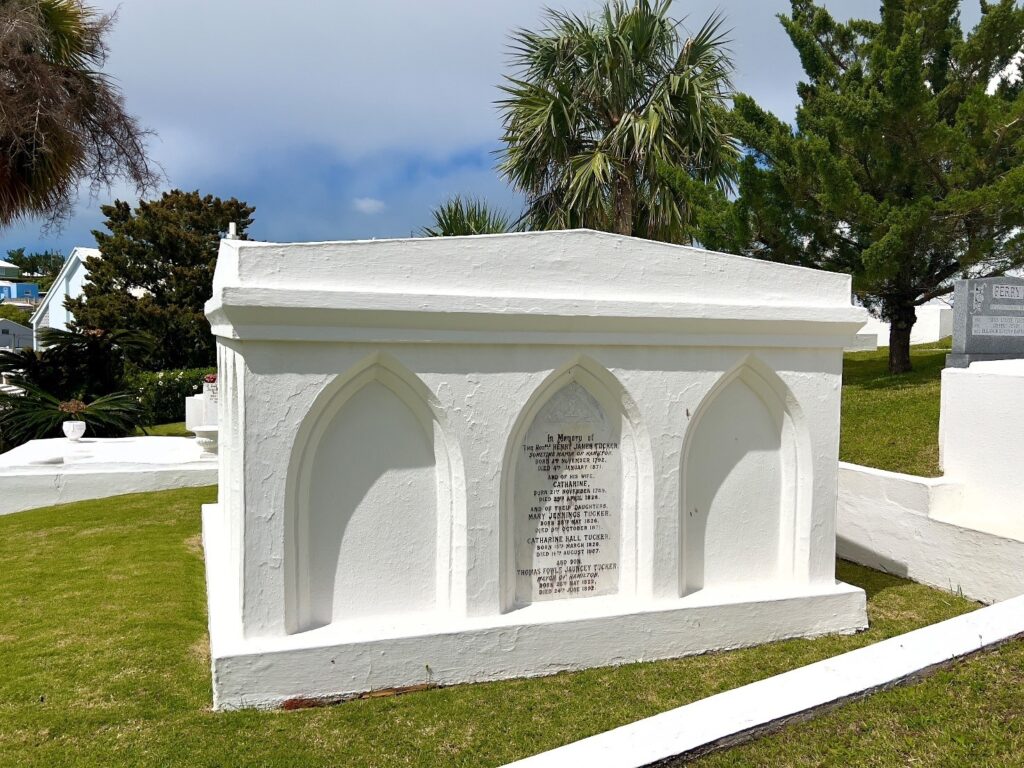
Humans are nothing if not creative, however. Elsewhere, others have found different solutions. The island of Bermuda measures only 54 km2/21 mi2 and lies 965 km/600 miles away from the nearest landmass. Formed entirely from volcanic activity, it is no small wonder that Bermudians affectionately refer to their home as “the Rock”. It was first settled in the 1600s and became known to the wider world after Shakespeare’s The Tempest dramatized the wreck of the Sea Venture on Bermuda’s soon- to-be-famous reefs. So removed from the world—and with such a small landmass which was so desperately needed as arable land—how were the first settlers to deal with their dead? Necessity being the mother of innovation, early Bermudians very quickly stumbled upon a practical solution: rather than burying their dead, they raised them up instead. Upon death, individuals were buried in sequential “floors” of familial towers, so that each generation was entombed upon the one that came before. This freed up valuable land for agriculture and literally contributed to the solid social foundation upon which the nation was built.
…and doing it sustainably
In 2002, Mary Woodsen of Cornell University, New York made some shocking estimates about the sustainability of current burial practices. Every year, traditional burials put more then an Olympic swimming pool’s worth of embalming fluid, enough hardwood to build more than 1123 homes, the equivalent of 13000 elephants in steel, 233,714 elephants’ worth of reinforced concrete and 4,000 elephants’ worth of copper and bronze into US soils alone. From these figures, it is easy to imagine that cremation may be the more responsible option. Unfortunately, as further research later discovered, each cremation releases between 0.8 and 5.9 grams of toxic mercury, of which 75% goes into the air and the remainder settles into the ground and water. Interestingly, you could drive about 7,772 km on the energy equivalent needed to cremate someone.
Students of human history know that there is often a relationship between the effort and/or money placed in the grave and the status achieved or ascribed by the deceased. That funerals were expensive in terms of the environment is also not new; burial mound builders throughout prehistoric Europe used the most fertile agricultural topsoil to entomb their most powerful leaders, removing that crucial resource from societies that depended upon farming for their daily lives. That being said, the environmental cost of traditional funerals has now reached a proportion that is far beyond our ability to sustain it. As Native American Chief Seattle is quoted as saying “we did not inherit the earth from our ancestors; we borrow it from our children”. A sustainable burial may be the last gift we can give. For this reason, we may wish to choose a burial which is truly traditional, and return to the pared-down, un-embalmed funerals allotted to Homo naledi which are today called ‘green’, ‘natural’ or ‘eco’ burials and pay that gift forward.